URD Hosts Greek Scholars for Dialogue on War and Peace
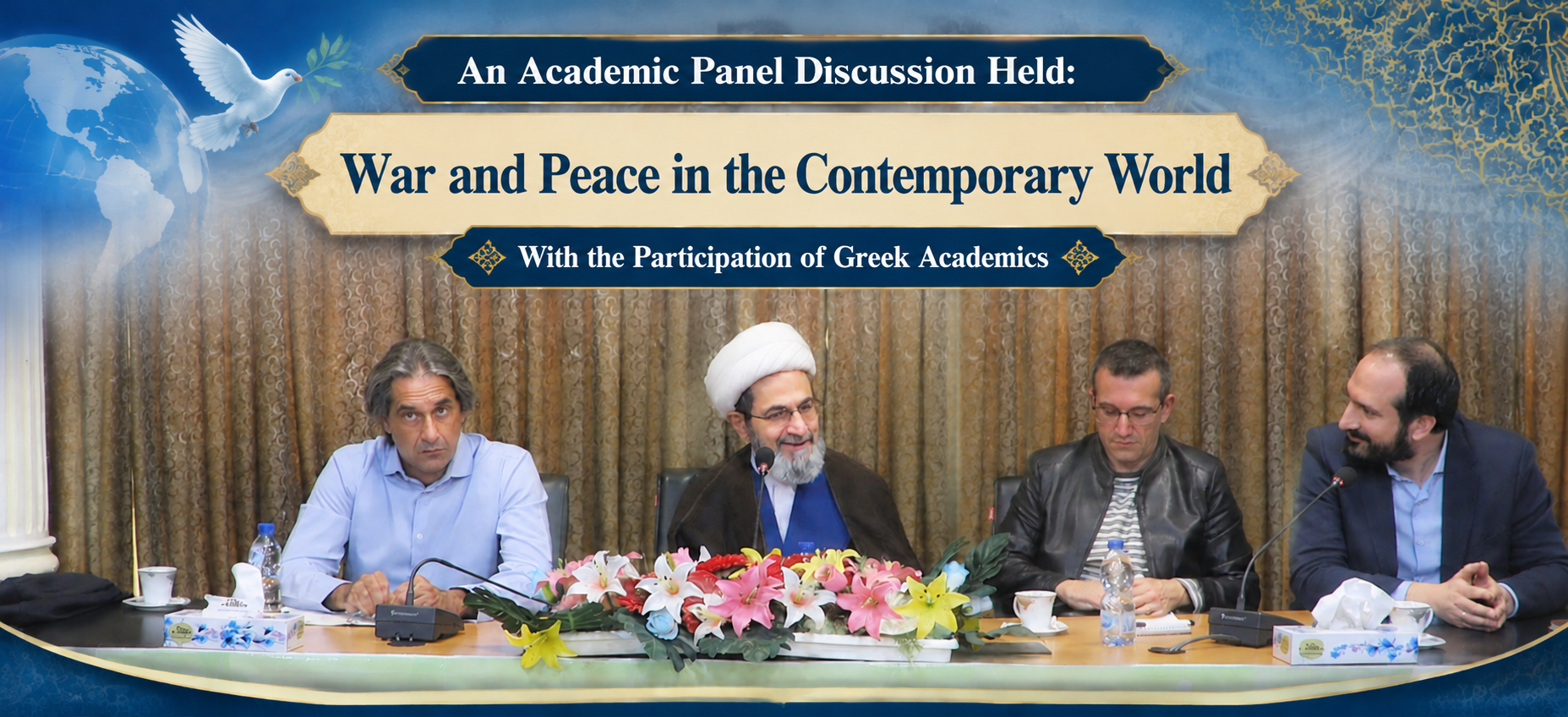
The Center for Peace and Dialogue at the University of Religions and Denominations (URD) held an academic seminar entitled “War and Peace in the Contemporary World: An Interdisciplinary Dialogue on International Law, Moral Principles, and Religious Teachings,” bringing together distinguished scholars from Greek and Iranian universities.
Opening Remarks by Session Chair Dr. Mohammad Taher Gholitabar
Dr. Mohammad Taher Gholitabar, Director General for International Affairs and Director of the Center for Peace and Dialogue at URD, warmly welcomed the Greek academic delegation and commended their courage and sense of academic responsibility in visiting Iran amid sensitive regional circumstances.
He also highlighted the history of academic cooperation between the University of Religions and Denominations and universities in Thessaloniki and Athens.
Prof. Grigoris Zarotiadis — Aristotle University of Thessaloniki
Prof. Grigoris Zarotiadis expressed his appreciation for the hospitality of the University of Religions and Denominations and outlined the principal purpose of the delegation’s visit.
“First, I would like to express our deepest gratitude for your hospitality. The main reason for this delegation’s visit is that we felt our responsibility as members of the global academic community is not limited to research and teaching, but also requires us to be present and active in difficult times and to express solidarity with our colleagues, brothers, and sisters around the world,” he said.
Turning to the historical relationship between the two countries, he added: “The second reason is that the civilizational ties between the Iranian and Greek peoples extend back more than 3,000 years. Over these millennia, we have learned to use our differences not as grounds for conflict, but as a foundation for mutual respect, new ideas, and scientific and philosophical achievements. What is missing in the contemporary disorder of the world is an understanding of this very principle: that a plurality of perspectives is not a source of violence, but a source of progress.”
Discussing global economic and political conditions, Zarotiadis said: “Economic and political analysis suggests that we are living in a ‘pre-revolutionary’ era—one in which the gap between the immense possibilities offered by technology and the harsh realities of people’s lives has grown considerably. This situation disproves Fukuyama’s thesis of the ‘end of history’ put forward in the 1990s. History has returned, and we face a dilemma: either we must save history or suffer its consequences. We must move beyond capitalism toward just and ethical governance grounded in mutual respect and love.”
Dr. Panayotis Kourgiotis — University of Macedonia
In a legal analysis, Dr. Panayotis Kourgiotis emphasized the significance of visiting Iran at a critical time when, he said, the country was facing unjust aggression by imperialist and Zionist powers.
He described the pressures exerted on Iran in recent decades as a war on multiple fronts: an economic war through sanctions, a diplomatic war aimed at isolation, direct military warfare, and a war of media propaganda.
Kourgiotis identified four principal reasons for the aggression against Iran:
- Its refusal to submit to the proposed “New Middle East”;
- Its independent exercise of regional sovereignty without interference in the affairs of neighboring countries;
- Its peaceful use of nuclear technology and its domestically driven scientific and technological advances; and
- Its courageous resistance and material and moral support for the oppressed peoples of Palestine and Lebanon.
Criticizing what he described as the European Union’s passive policies toward the United States, he added: “European countries displayed hypocrisy following Trump’s withdrawal from the JCPOA in 2018. Our duty as university academics is to return to our countries and explain to our students and the wider public the legitimacy of Iran’s defense.”
Dr. Alexis Lekakis — Panteion University, Athens
Dr. Alexis Lekakis discussed the turbulent transition from a unipolar to a multipolar world order, describing it as a process accompanied by genocide in Gaza and crimes in Lebanon and Yemen.
Referring to the attack on Iran, he characterized it as an attack on the Iranian nation as a whole, including the country’s infrastructure, hospitals, and schools.
Lekakis argued that the principal reason for Western hostility toward Iran was not its nuclear program, but its political independence and refusal to abandon the Palestinian cause.
He also referred to remarks made in Greece by the U.S. Secretary of State concerning historical hostility between Iran and Greece. He described those remarks as a misuse of Greek history to promote a “clash of civilizations” narrative, emphasizing that the history of the two peoples bears witness to mutual influences and constructive cultural exchanges more than to confrontation and conflict.
Rejecting the “clash of civilizations” narrative as deeply biased, he offered a historical example: when the Byzantine emperor closed the Academy of Athens, Greek philosophers sought refuge at the court of the Sassanian king Khosrow Anushirvan, where their works were preserved.
He concluded by expressing his profound solidarity with the noble people of Iran.
Remarks by Hojjatoleslam Dr. Mohammad Masjed Jamei
Hojjatoleslam Dr. Mohammad Masjed Jamei, Senior Adviser to the President of the University of Religions and Denominations and former Iranian Ambassador to the Vatican, recalled hosting Ecumenical Patriarch Bartholomew, the Orthodox Christian leader, during his tenure as Director General for Cultural Affairs at Iran’s Ministry of Foreign Affairs.
He recounted that the Patriarch had recognized structural similarities between Orthodox religious art and Iranian-Islamic art and had proposed offering scholarships to Iranian students to study Byzantine culture in Thessaloniki.
Masjed Jamei also expressed his appreciation for the Greek scholars’ fair-minded and courageous analyses in support of the Iranian people’s legitimate rights.
Three Proposals for Strategic Academic Cooperation
On behalf of Aristotle University of Thessaloniki, Prof. Zarotiadis presented three practical proposals for consideration and approval:
- Signing a memorandum of understanding on academic cooperation;
- Establishing an international network of universities of ancient civilizations;
- Organizing a global conference on religion and sustainable development.
Closing Remarks
In his concluding remarks, Dr. Gholitabar described the University of Religions and Denominations as a unique center dedicated to the academic study of all religions, noting that it had hosted numerous international delegations.
He characterized the Greek scholars’ presence in Iran under the prevailing sensitive circumstances as a sign of genuine friendship and academic courage, and expressed his appreciation for their profound support.