The Co-Believers: Narratives of Christian Devotion to the Ahl al-Bayt
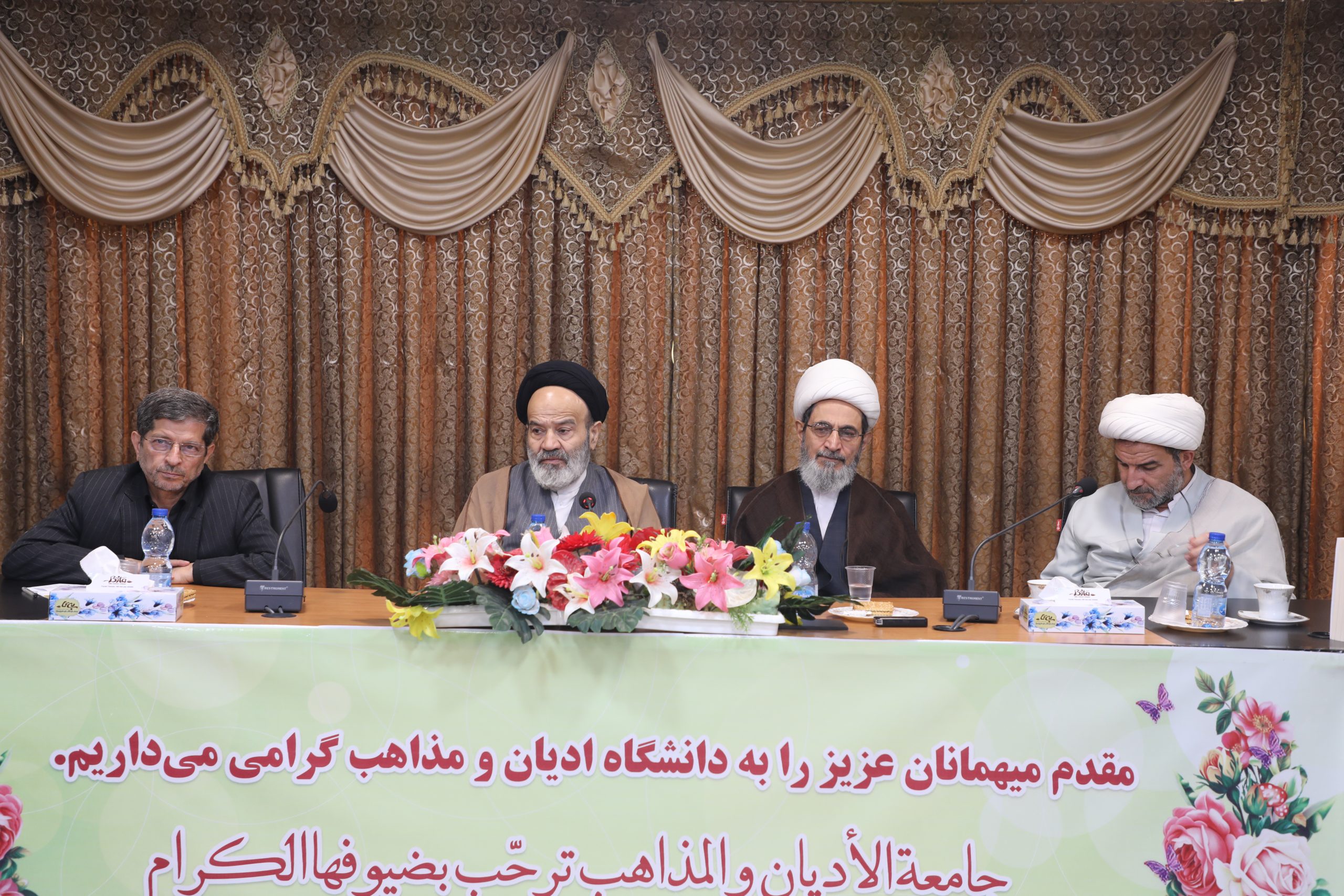
An academic session centered on the review and introduction of the book The Co-Believers (Ham-Bavaran) was held at the University of Religions and Denominations, featuring the book’s author, Dr. Abbas Khameyar, who also serves as the advisor to the university president on international affairs.
The session, organized in collaboration with the University’s Research Department and the Seminary’s academic Association of Religions and Denominations, aimed to analyze the various dimensions of a work that narrates stories of the profound affection of prominent Christian figures for the Ahl al-Bayt (AS). The event was well-received by professors, researchers, and students.
Dr. Farmanian, the secretary of the session, began by highlighting Dr. Khameyar’s history as Iran’s cultural attaché in Lebanon and other Arab countries. He shared memories of his extensive connections with Christian figures in the region and described Dr. Khameyar as a noble, insightful individual with significant academic and religious standing. Citing the book’s content, he mentioned prominent figures such as George Jordac, Suleiman Kettani, Antoine Bara, and Michel Kadé, framing the work as the product of years of deep interaction and friendship rather than a mere formal report or administrative interview.
Subsequently, Dr. Mohammad Masjed-Jamei (Senior Advisor to the President of the University of Religions and Denominations and former Iranian Ambassador to the Vatican), as the first speaker, elaborated on the unique characteristics of Lebanon. He emphasized that the perception of Lebanese Christians toward Islam, Shi’ism, and Iran differs fundamentally from that of Christians in other regions, such as Egypt or Iraq.
Referring to the historical background of modern schools established by missionaries in Lebanon since the late 18th and 19th centuries, Dr. Masjed-Jamei noted that these schools, unlike those in many other regions, had a literary and cultural approach. Consequently, Lebanese graduates developed a deeper understanding of the literature and historical concepts of the Islamic world. He cited Nahj al-Balagha as the “gateway” through which Lebanese Christians entered Arab literary identity and subsequently became acquainted with Imam Ali (AS) and Imam Hussain (AS), describing this flow as the catalyst for enduring works that sometimes surpassed what Shi’a themselves have produced in this field. The former ambassador also pointed to Iranian cultural and artistic elements, such as the subtleties of poetry and curved architecture, which serve as civilizational attractions for Iran in the hearts of Middle Eastern Christians, beyond political dimensions.
He concluded: “This current created works that were far stronger than those created by Shi’a. A Sunni, in the best case, views Ali (AS) as one of the Rightly Guided Caliphs and has no motivation to know Ali himself. But a Christian recognizes Ali through Ali himself. His gateway is world literature, and when he encounters this text, the result is far beyond what has usually been written.”
Next, Hojjat al-Islam Seyed Abolhassan Nawab (Founder and faculty member of the University of Religions and Denominations) began by referencing the open scientific and cultural environment of the university, enabled by the support of the late Leader of the Islamic Revolution, Imam Khomeini. Sharing a personal anecdote about a Lebanese Christian official’s devotion to Imam Hussain (AS)) during Muharram, he highlighted the depth of the Ahl al-Bayt’s influence on the social fabric of Middle Eastern Christians, especially in Lebanon. Professor Nawab stressed the inherent unity of Abrahamic religions, citing the verse “Indeed, the religion in the sight of Allah is Islam” (submission to God), and characterized the differences as being in the Sharia (laws) and Manhaj (methods), rather than the core principles of monotheism and prophecy.
The founder of the university explained: “Therefore, the relationships of Middle Eastern Christians—whether in Jordan, Syria, Iraq, Lebanon, or Iran—are completely different from those of Christians in Europe and America. Their beliefs, faith, and religion are not comparable to them. What Dr. Khameyar has collected are the views of devout Middle Eastern Christians who consider themselves part of our family. They feel no separation between themselves and us.” He praised the book The Co-Believers as a manifestation of this transcendent unity.
The third speaker, Dr. Ahmad-Reza Meftah (Research vice president of the university and member of the Seminary’s academic Association of Religions and Denominations), approached the topic theoretically, categorizing interfaith dialogue into three types: cognitive (epistemological), existential (heart-based), and functional. He noted that most official and institutional dialogues remain at the first (cognitive) level with little success in functional arenas. He lauded Dr. Khameyar’s work as a prime example of “existential/heart-based” dialogue, which is rare and highly impactful. He pointed out that the author and his interlocutors achieved a level of impact through honest and intimate conversation that is rarely seen in formal diplomatic meetings. Dr. Meftah stressed the importance of reading this book, particularly through the eyes of non-Muslim audiences, and emphasized the necessity of translating it into various languages to introduce the Ahl al-Bayt from a new angle.
He reiterated that Lebanese Christians perceived Imam Ali (AS) and Imam Hussain (AS) through their own literary approach to religious texts, not through inheritance or stereotypical propaganda. He cited the book by Suleiman Kettani as evidence that Christian figures have been able to offer a first-hand, fresh narrative of the life and words of the Commander of the Faithful, which is sometimes even new to the Shi’a themselves.
In the final segment, Dr. Abbas Khameyar (author of The Co-Believers) described the motivation and process behind the book, clarifying that it is not merely an analytical work but the result of “lived experience and a spiritual journey of nearly four decades” with prominent Christian figures. He spoke of George Jordac, author of the seminal book The Voice of Human Justice, and others like Joseph Al-Hashim and Suleiman Kettani, noting their devotion to a civilizational Iran, not just a political one. He emphasized that the book contains documented, precise information, not just emotional narrative. He mentioned the introduction by Ayatollah Seyed Mostafa Mohaghegh Damad and announced that the book is currently being translated into Arabic and English.
He shared stories of poets like George Zaki Al-Haj and George Chakkour, and mentioned Suleiman Kettani’s 11-volume work on the Infallible Imams. Dr. Khameyar revealed he has authored a 700-page research paper on this subject, attributing the gateway to the Ahl al-Bayt’s world to Nahj al-Balagha, which leads to the tragedy of Karbala and the shared suffering of Imam Hussain (AS) with Christ.
The session also featured a video clip of an interview with Bishop Hossam Yuhanna Darwish, a bishop from the Beqaa region of Lebanon and head of the Episcopal Committee for Islamic-Christian Dialogue, who expressed his profound love for the Ahl al-Bayt and emphasized the necessity of empathy and convergence between Muslims and Christians to face shared challenges.
The specialized academic session for the review and introduction of The Co-Believers concluded with appreciation for all speakers and an emphasis on the necessity of utilizing such valuable works to enrich cultural programs, as well as an update on upcoming plans for the translation and republication of the book.